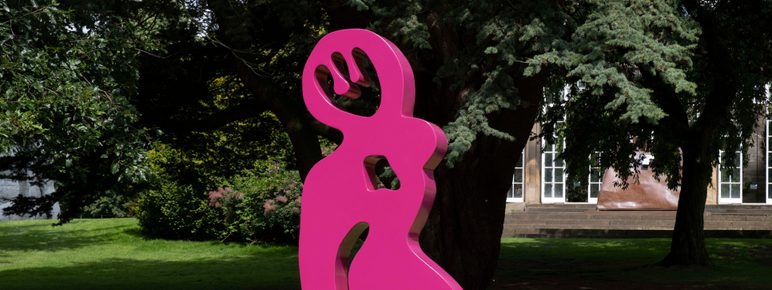
Alice Irwin: Streaky Dance
Art OutdoorsAlice Irwin: Streaky Dance
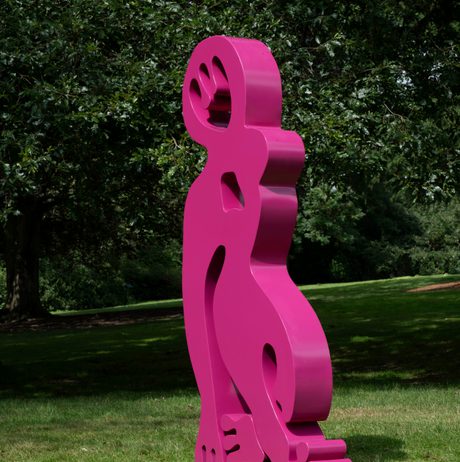
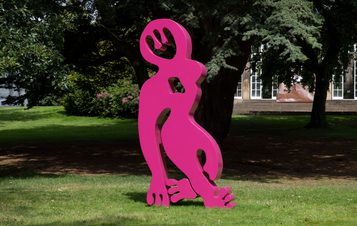
Alice Irwin’s (b. 1994) work explores the relationship between figurative and abstract imagery. Her distinctive visual style combines simplified body shapes, repeating symbols and bright colours, typically pink, orange and blue. Childhood experiences, games and memories are common themes in the artist’s sculpture and printmaking. There is an intentional naivety in her work, but this is often paired with a deeper consideration of the more complex aspects of human identity. Although her works are playful, they can also feel unsettling in their faceless anonymity.
The form of Streaky Dance has recurred in Irwin’s work for several years. However, while other sculptures, including Peeps and People Play, are not gendered, for this work she was drawn to the female form to consider how women see themselves and their bodies. It aims to encourage us to embrace who we are and to come together to acknowledge and enjoy our uniqueness. With one foot raised off the ground in a joyful stance, Streaky Dance captures a sense of motion and invites people to move and celebrate their bodies.
Alice Irwin graduated from the Royal College of Art in 2018. In the same year, she exhibited in the Bothy Gallery at YSP where she showed a selection of prints alongside new sculpture. In 2020 she was commissioned to make a major group of 11 works for The Piece Hall in Halifax, and has recently appeared on Sky Art’s Landmark programme.

You may also like
- Profile
Sarah Jane Palmer
Artist Educator - Profile

Sue Stuart-Smith
- Art Outdoors
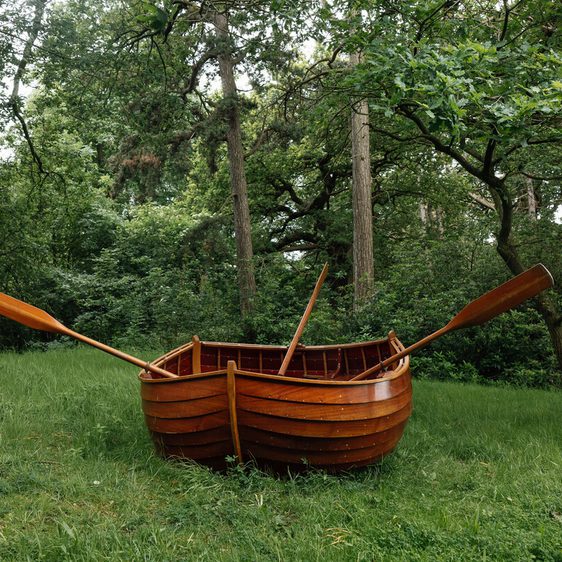
JocJonJosch: Eddy
Eddy continues JocJonJosch’s investigations into collaboration. The round boat with three oars is symbolic of the collective’s dynamic, in which Joc, Jonathan and Joschi wrestle towards a destination. There is a sense that each time one would attempt to move forward, his movement would be countered by the action of the other two, leaving them literally turning in circles. - News

Staff Profile: Grace Harvey, Retail Supervisor at YSP
21 November 2024