
Antony Gormley: One and Other
Art OutdoorsAntony Gormley: One and Other
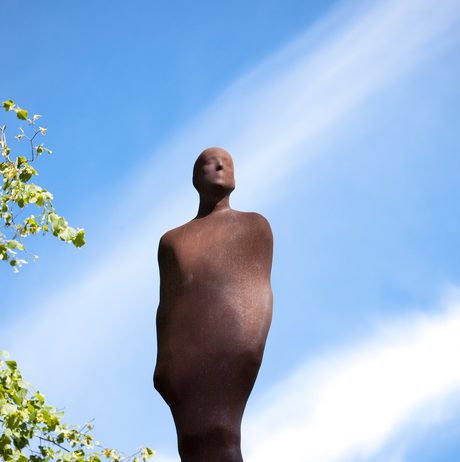
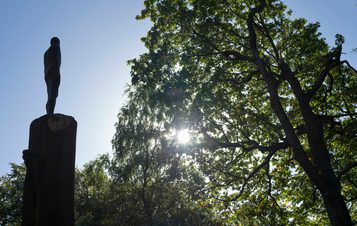
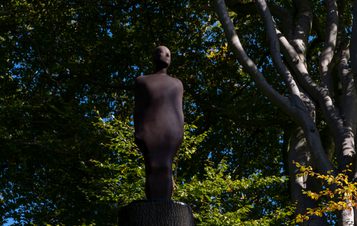
One and Other is a solitary figure overlooking the landscape from the top of a tree trunk. It has no distinct features, making it seem both anonymous and universal. Placed at this height, the work becomes a beacon in the landscape, but the figure remains out of reach and distant. Made from cast iron, the material has rusted naturally and its colour has deepened over the passing years.
Antony Gormley describes his work as an inquiry into the body “as a place of memory and transformation”. Although his sculptures are often based on casts of his own body, he does not see them as statues of himself. He has described them as “the place where a particular body once was and anybody could be”. His work invites us to consider our place in the world around us, as well as our relationship to time and space.
I would say that the whole way that I have approached the body is as a space not a thing – not an object to be improved or idealised, but simply to be dwelt in.
- Antony Gormley
Antony Gormley (b. 1950) is one of the UK’s best known sculptors. His monumental Angel of the Northstands alongside the A1 in Gateshead, and his collection of figures titled Another Placelook out to sea on Crosby Beach in Liverpool. He has exhibited across the world in galleries and public spaces. In 1994 he was awarded the Turner Prize and has been a Royal Academician since 2003.
Courtesy of the artist. The display of this sculpture has been made possible by the provision of insurance through the Government Indemnity Scheme. Yorkshire Sculpture Park would like to thank HM Government for providing Government Indemnity and the Department for Culture, Media and Sport and Arts Council England for arranging the indemnity.
You may also like
- Art Outdoors
Anthony Caro: Dream City
- Art Outdoors
Joao Vasco Paiva: Standard Kitchen
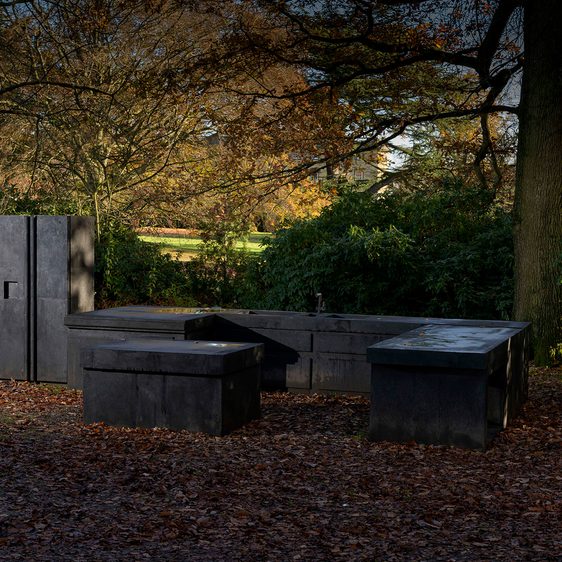
For Standard Kitchen, Vasco Paiva collaborated with artisans in East Bali. Together, they used the traditional method of carving Batu Candi, a lava stone often used for building temples and shrines. The stone was shaped to create a life-sized replica of a modular kitchen to consider the processes and spaces that are integral to everyday life. - Art Outdoors

Grenville Davey: Well
- Art Outdoors

Ursula von Rydingsvard: Damski Czepek
Damski Czepek translates as ‘lady’s bonnet’, and has a central hood-like form, with snaking ribbons extending out into the landscape. The shape welcomes you in and envelopes you, and echoes some of the eighteenth-century follies across the estate, such as the Shell Grotto.