Jakob Rowlinson: the act of becoming
Jakob Rowlinson: the act of becoming
the act of becoming
Jon Horrocks
On entering Jakob Rowlinson’s studio, the smell hits first: rich, animalic leather. His recent work has been preoccupied with the material and symbolic significance of leather in queer history. The same scent would have permeated the medieval tannery on which The Art House in Wakefield now stands. During the gallery’s construction in 2008, the remains of two wooden vats – once used to store the urine required for tanning – were discovered beneath its foundations. Leather was a key material and commodity in medieval Europe, yet tanneries were typically confined to the outskirts of towns because of the process’s malodorous fumes and toxic by-products. While researching his forthcoming projects at The Art House and Yorkshire Sculpture Park, Rowlinson noticed a symbolic parallel between those working in medieval tanneries and the LGBTQ+ community – both historically marginalised from society. This sensitive and adaptive approach to uncovering resonances between the past and the present lies at the heart of the artist’s practice.
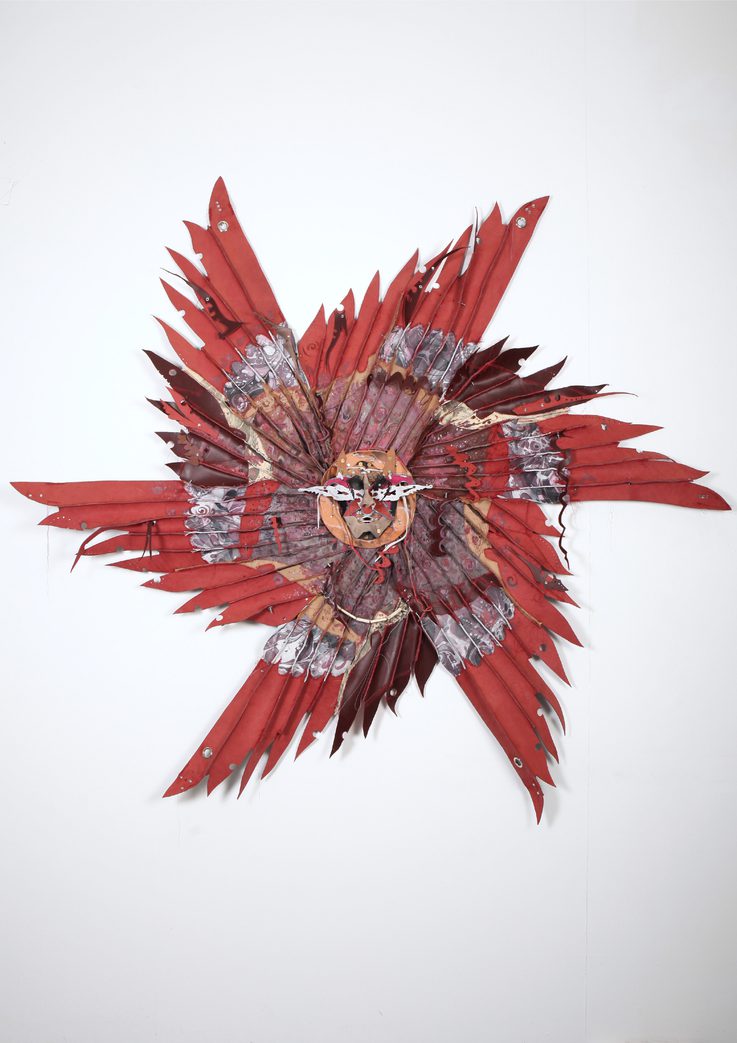
Rowlinson has created a new series of leather masks for his exhibition, REVIVER, at The Art House. Ogling and open-mouthed, they recall medieval grotesques, stone carvings of mythical creatures, demons, and human-animal hybrids that adorn Gothic cathedrals. Constructed from reclaimed clothes and accessories, often from Rowlinson’s own wardrobe, they also nod to the longstanding relationship between leather subcultures and the gay community. Like carnival, these spaces have historically provided an arena for transgression. Fetish clothing enables the wearer to transform their identity, express repressed desires, and challenge the limits of the heteronormative body.
This invocation of the carnivalesque recalls the eponymous concept developed by the Russian philosopher Mikhail Bakhtin (1895-1975). Drawing on the spirit of the medieval carnival, Bakhtin used the term to describe the temporary suspension of social hierarchies through humour, chaos, and parody, and to examine how these dynamics manifest in visual and literary culture. As he writes,“carnival brings together, unifies, weds, and combines the sacred with the profane, the lofty with the low, the great with the insignificant, the wise with the stupid” (Bakhtin, 1984, p.123). In the Middle Ages, celebrations such as the Feast of Fools reversed social hierarchies, enabling clergy and peasants to swap roles with lords and bishops, mock authority, and crown individuals as ‘Lords of Misrule’ or ‘Fools’ to rule for a day.
Bakhtin argued that the carnivalesque offers a temporary release from institutional and social constraints. By collapsing binaries – sacred and profane, high and low, rich and poor – it creates a space in which marginalised voices can emerge, and alternative ways of life can be imagined. The carnivalesque invites us to consider what life might look like if established hierarchies and norms were suspended. Rowlinson’s work operates in much the same way. Begging to be worn, one can imagine his costumes being activated in a collective, carnivalesque act of queer celebration.
It is through the grotesque that the carnivalesque finds visual expression. In contrast to the idealised human form celebrated in Classical and Renaissance art, Bakhtin’s “grotesque body” is open, mutable, and perpetually in “the act of becoming” (Bakhtin, 1984, pp. 317-18). In this sense, the grotesque body resonates with queerness as a concept that resists fixed categories, remaining fluid, transformative, and in a constant state of flux.
In this spirit, themes of transformation and self-renewal run throughout both presentations. Inspired by the metamorphic life cycle of butterflies and their symbolism within queer and trans communities, Rowlinson employs them as a recurring visual motif. During a 2024 residency at Yorkshire Sculpture Park, he was drawn to the ostentatious markings of Orange-tip and Comma butterflies found there, reinterpreting their distinctive patterns with filigreed leather, marbling, and handmade dyes made from acorns foraged across the grounds. Several masks also appear to be physically evolving into butterflies or cherubim, with outstretched wings emerging from their leering faces. Merging the human with the animal, the profane with the sacred, this state of hybridity precisely embodies the essence of Bakhtin’s grotesque.
This engagement with the grotesque reaches a climax at Yorkshire Sculpture Park, where Rowlinson draws on biblical descriptions of angels. Suspended above the Visitor Centre concourse, ROTATOR features three monumental, glistening sculptures that serve as guardians of the space. Here, the artist elevates queerness to the status of a celestial being, positioning it as a form of transcendence that exceeds the limits of the heteronormative body. Discussing these works, Rowlinson explains that “the colours I am using in these hanging sculptures also have certain significance. In alchemy, Black, White, and Red represent the three foundational phases – otherwise known as the magnum opus – required to transform base matter into the Philosopher’s Stone.” The alchemical symbolism in these works reinforces the themes of metamorphosis that run across both spaces.
In Rowlinson’s hands, history becomes elastic in his pursuit of queering the archive. Like Bakhtin’s grotesque body, the past is never fixed or complete but perpetually in the act of becoming. Viewing the Middle Ages as a site of queer potential, Rowlinson uses leather to piece together an alternative history that challenges conventional narratives of the past and points towards a more inclusive future.
Jon Horrocks is a consultant, curator, and writer living in London.
References: Bakhtin, M. M. (1984). Rabelais and His World. Translated by Hélène Iswolsky. Bloomington: Indiana University Press.
Essay commissioned by The Art House (TAH) to accompany the exhibition REVIVER, a solo exhibition at TAH, and ROTATOR, an installation at Yorkshire Sculpture Park, 2026.
Image: Jakob Rowlinson, Ekpyrosis, 2025.